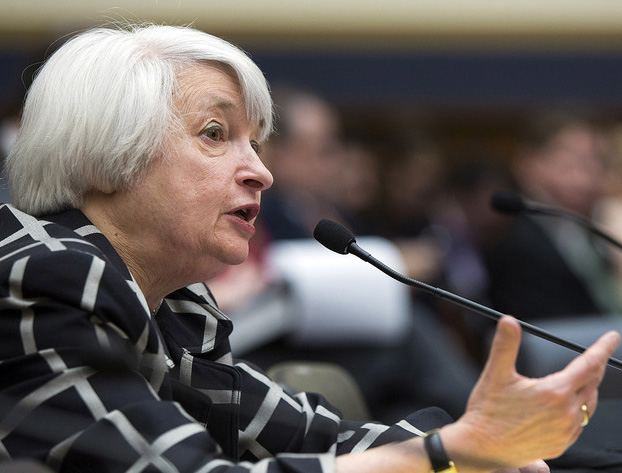
“This is how it is. Got it?”
12 February 2014 4:08
Janet Yellen completed her first day of testimony on Capitol Hill as Chair of the Federal Reserve. While the event was historic, it was remarkable mainly for how unremarkable the actual testimony was. There is a great deal of continuity in the Fed from Bernanke to Yellen, who both have very similar approaches to both policy and communication.
What was left unsaid was probably more important, however. We live in a time with a very active Fed which is taking a bigger role in the economy than any central bank in US history. But congress appears to be very comfortable with that role and very willing to let Yellen do what she does best – place a firm hand on the tiller and guide the economy as close to full speed ahead as it can chug along.
“This is how it is. Got it?”
We didn’t learn an awful lot new from Yellen’s prepared remarks. It was all generally positive, if tentative, which is about all anyone has been able to say about the economy we have today. “Since the financial crisis and the depths of the recession, substantial progress has been made in restoring the economy to health and in strengthening the financial system,”she told Congress, but, “Still, there is more to do.” The details can be summarized very quickly:
Yellen did not defend the Fed’s decision to “taper” their bond-buying program this year, but did emphasize that unemployment remains unreasonably high. She did state that there is no unemployment target, previously speculated to be a target of 6% or less. All these numbers and targets, however, were not the most interesting parts of her testimony.

The presses keep rollin’
Her openness and clarity is in stark contrast with Alan Greenspan, once famous as an oracle who made a point of never speaking clearly about anything in front of Congress. He even had an aide hold a laptop with the live stock market traces, just in case he accidently said something that moved the markets and could make a quick correction. Not so with Bernanke, who was always open about targets and policy without a care as to how it went down. Yellen is pursuing the same path, and clearly it is what the world has come to expect.
The other very interesting part of her testimony came after the prepared remarks, when the members of Congress had a chance to ask questions. There is no way to describe this Fed as anything but activist, taking a much more visible and dynamic role in the economy than it ever did before 2008. All the questions were essentially softballs, save a question about auditing raised by Rep. Bachmann (R-MN). Yellen easily dismissed it, saying, ““Almost every aspect of our financial affairs” is already audited by the GAO. “What I don’t agree with and would strongly oppose is interfering with the independence of monetary policy by bringing political pressures to bear.” And that was that.
This is especially remarkable given that by any measure the bond buying (aka QE3) and net zero Fed Funds Rate is in contrast to an estimated 1% calculated as a reasonable and typical level. Yellen is comfortable playing a much bigger role in the economy and goosing things as much as possible – and Congress has clearly given this their tacit acceptance.
 Yellen did step back from a more active role in response to two questions. Rep Hinojosa (D-TX) asked about income inequality, to which the Chair replied, “It’s one of the most important issues and one of the most disturbing trends facing the nation,” adding that “Rising inequality is partly a matter of a weak job market that we are trying to address.” In other words, we are on it already as best we can be.
Asked whether the stock market is becoming a bubble, she dismissed the question saying “Our ability to detect bubbles is not perfect, but looking at a range of traditional valuation measures doesn’t suggest that asset prices broadly speaking are in bubble territory.”
In short, the Fed is piloting the economy and Congress largely didn’t object. The stock market seems to approve, too, with the DJIA responding favorably – where it had been down as much as 6.5% this year, it’s now down only 2.7% after a post-Yellen rally.
The open, activist Fed seems to suit everyone’s needs right now and hardly anyone is complaining. It’s good to know that someone is in charge that has a plan and knows what she is doing. But let’s not forget that the Fed has a limited number of tools they can use and is definitely not elected by anyone.
Posted by Erik Hare
Tags: congress, Economics, economy, federal reserve, interest rates bond buying, policy, Yellen
Mobile Site | Full Site
Get a free blog at WordPress.com Theme: WordPress Mobile Edition by Alex King.
I am very excited to have a woman as the most powerful person in the world! Janet may be a lot like Bernanke but I expect there will be changes as she takes over the job.
By annalisecudahy on 12 February 2014 at 16:50
There may be a few, but I wouldn’t expect too much. She seems as open as Bernanke and will probably continue to be about as available.
By Erik Hare on 12 February 2014 at 18:35
Are they going to taper or not? I am confused after reading her testimony.
Good blog BTW
By djsamuelson23 on 12 February 2014 at 22:23
I believe they are going to continue tapering, but not go to zero. So expect a buy between $0-85M each month.
I could use that kind of money to play with. 🙂
By Erik Hare on 12 February 2014 at 22:28
Let’s try to remember the increase in the number of those not in the labor force. It increased by 12 million since the start of 2008.
Not in the labor force means that they are not in the workforce and not looking for a job.
The economy doesn’t want them and they lost faith in the economy.
By Mariele on 13 February 2014 at 5:04
Actually, no – it has increased by about 6M since the start of the depression in 2000, and 4M of that is accounted for by disability and retirement. Those leaving the workforce involuntarily has not been significant since January 2012. The Philadelphia Fed report on this is found here and my summary of this report and the other effects is found here.
The total decline in participation since its peak in 2000 has been about 4 percentage points from 67% to 63%. This is about 6M people total in a workforce (over 16, not in military, jail or hospital) of 155M.
It will continue to fall as people retire, too, hitting 60% or even less by 2020 as the peak Baby Boom hits retirement age.
By Erik Hare on 13 February 2014 at 14:10
Demographics does explain some of the LFPR.
Anyway my point is that I don’t think there is enough evidence to taper.
Paul Krugman state on 2/3/2014 that
“Just doing the demographic correction reduces the employment gap — but it’s still big unless you accept the idea that the U.S. economy was above full employment even during the early-Bush slump years, and that by late 2007 it was a highly overheated economy on ”
http://krugman.blogs.nytimes.com/2014/02/03/demography-and-employment-wonkish/?_php=true&_type=blogs&module=BlogPost-ReadMore&version=Blog%20Main&action=Click&contentCollection=Opinion&pgtype=Blogs®ion=Body&_r=0#more-36444
The Fed made a big mistake in tapering in my view. While the tapering is not predetermined for the future, it is the wrong policy, given the employment to population ratio.
We need policies to push up the employment to population ratio since that is partially where economic activity comes from, (productivity, capital, demand and business creation and destruction being the other factors)
By Mariele on 13 February 2014 at 21:20
But with retirement, the percent of employees working WILL continue to drop, and there is little we can do to stop it.
I do favor a jobs program, and that is what the bond buying program really is in the end. But – this will all start to come out in the wash once there is a labor shortage in the 2020s. I expect 2017 is the year that everything changes, and I’m very much sticking with that.
Of course, we should do what we can to encourage employment growth today, but do it with an eye to restructuring the economy to the very new one that is arriving.
By Erik Hare on 14 February 2014 at 4:25
Gary Burtless of the Brookings Inst. writes that
“Many of the missing participants are young adults who have postponed entering the workforce or stopped seeking work as a result of their poor job market prospects. In contrast, Americans past age 60 have seen increases in their labor force participation and employment rates. Employment and participation rates in these older age groups are higher than they were before the recession began. Since the economic recovery began, weakness in the job market has primarily been reflected in low rates of net job creation. Until the government shutdown on October 1, layoff rates were low to moderate. Voluntary quit rates, though rising, have remained at unusually low levels. This leaves comparatively few vacancies for young labor force entrants to fill. Older workers, on the other hand, have the option of remaining in their jobs. Many of them are choosing this option, and both employment and participation rates among the aged have edged up during the recovery.”
http://www.brookings.edu/blogs/jobs/posts/2013/10/22-jobs-unemployment-rate-dips-low-burtless
By Karl on 14 February 2014 at 0:54
Exactly. This is why I have been focused on youth unemployment for over a year now.
But keep in mind that anything that says “Since the recovery began” is starting from the official “recovery” after the recession, which is to say in 2009. The low point for jobs was in January 2010, and we didn’t see significant improvement until the end of 2011. Since the start of 2012 there has been some improvement, if slow.
So I say that Brookings erred by looking at the official definitions of recession rather than the behavior of the job market itself, which has very much lagged any official “recovery”. And this goes to the heart of my argument that we have been in a Depression since 2000:
By Erik Hare on 14 February 2014 at 4:30
[…] for a lot of words to be written wondering what kind of leader she would be. Betting money was on more of the same, given her long tenure at the […]
By A More Open Fed? | Barataria - The work of Erik Hare on 24 March 2014 at 0:58
[…] many ways, this mimics the rise of the Federal Reserve as the ultimate economic power in the US. It, too, has been filling the gap left by an ineffective […]
By Scalia Scowls – Take Notice | Barataria - The work of Erik Hare on 29 June 2015 at 2:28